Colamone
A lightning-fast abstract duel: slide arrowed pieces, bank their values on the far side, and reach eight points before your foe.
Gameplay overview
Race for eight points
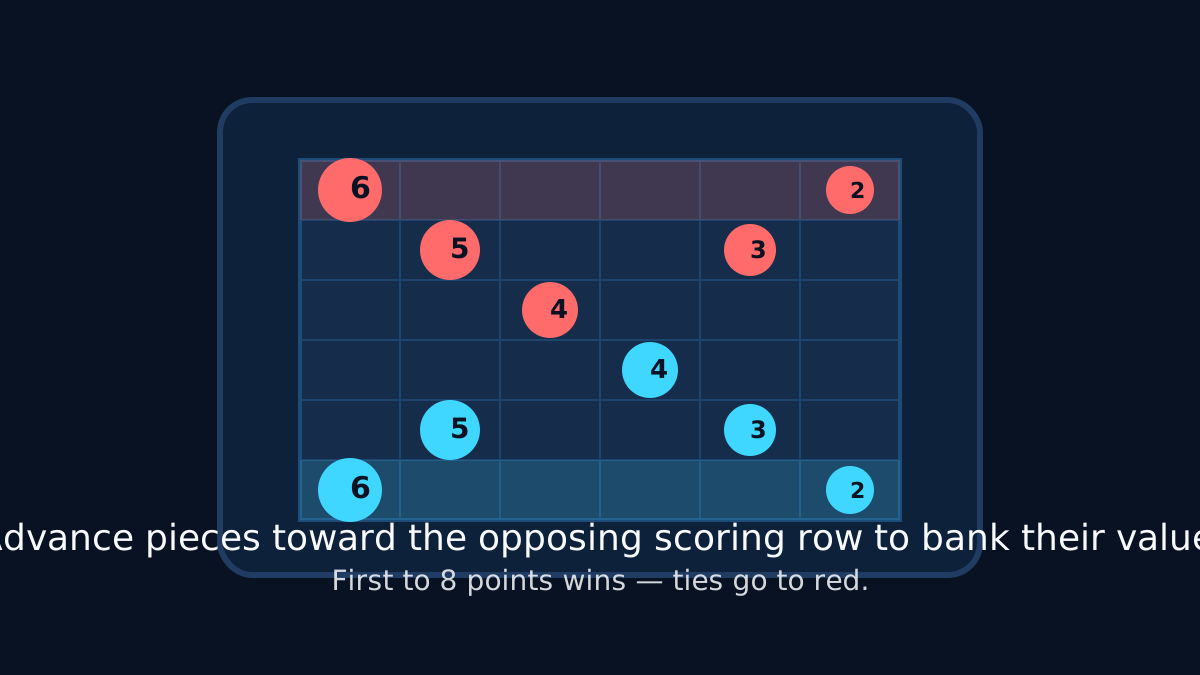
Colamone distills the tension of chess into a compact 6×6 board. Each piece is labelled 1–6 and can only move in the direction indicated by its arrow. March a piece into the opponent’s home rank to “bank” its value and add the number to your score. First player to reach eight points wins; if both sides tie on eight, the red player claims the victory.
Your objective
What you are trying to achieve
Colamone is a race to eight points. Slide your numbered pieces along their arrows into the opponent's home rank to bank their value, and be the first player to reach eight. If both players tie at eight, red is awarded the win.
Controls
How to play
- Click or tap one of your highlighted pieces to view the squares it may enter.
- Select a destination to move; captures occur instantly if an opponent occupies the square.
- Use the menu ribbon to restart, toggle sound, or switch between languages.
Colamone runs entirely client-side—play head-to-head on one device or pass the board back and forth. The simple interface makes it easy to share quick puzzles or teach the game to new players.
Beginner guide
Your first few minutes
Colamone explains itself in a minute, but the first match goes smoother if you follow a simple order.
- Click one of your highlighted pieces to preview the squares its arrow allows.
- Move a low-value tile first to feel how far pieces slide before they stop.
- Bank an early point by marching a small number into the opponent's scoring row.
- Watch which enemy arrows can reach your home rank and block those lanes.
- Use the menu ribbon to restart when you want to test a fresh opening.
Advanced tips
Outpace your rival
- Lead with high-value tiles early; even a single six reaching the far row forces your opponent to respond.
- Block lanes by parking low numbers in front of the opponent’s arrows, buying time to set up your own scoring run.
- Keep an eye on parity—because ties go to red, blue must aim for nine total points or deny red’s final score.
Movement & scoring
Directional movement
Each number corresponds to a movement vector: the arrow that appears on the piece shows the single direction it may travel. Pieces may advance any number of squares along that line until they collide with the edge, a friendly piece, or an enemy piece—capturing removes the enemy tile and drops yours on that square.
Banking points
When a piece enters the opposite scoring row, its value is locked in and the piece leaves the board. Your running total is displayed beside the board. If you cannot move any pieces, the higher score wins; in a tie, red prevails automatically, so blue must push past parity.
Our take
Why Colamone deserves a spot in your abstract rotation
Colamone hits a sweet balance between simplicity and depth. The 6×6 board and race-to-eight rule are easy to explain, but the directional arrows on each piece create surprising tactical nuance. Choosing whether to cash in a high-value tile for points or keep it on the board as a threat, blocking an opponent’s arrows by parking small numbers, and playing around the “ties favour red” rule all add layers of positional play that go far beyond the minimal rules text.
Because games are short and the ruleset is deterministic with no hidden information, Colamone works wonderfully as a “thinky filler” between longer games. It’s also well suited to post-game analysis—you can look back at a single mis-timed banking move and see exactly how it handed your opponent the tempo. That clarity makes it a great teaching tool for planning ahead and evaluating trades.
Who will enjoy it?
- Fans of chess, go-inspired abstracts, or modern minimalist designs like Hive and Onitama will find a lot to like here. It’s approachable enough for new players but deep enough to reward repeated play, especially if you enjoy exploring openings and sharing puzzles based on interesting mid-game positions.
Frequently asked questions
Need a quick answer?
- How do you play Colamone?
- Select a numbered piece, follow its arrow to move any distance, and slide into the far scoring row to bank its value.
- What is the goal in Colamone?
- Reach eight points before your opponent by banking your pieces in their home rank; if the score ties at eight, red wins.
- Can you play Colamone on mobile?
- Yes. You click or tap the board, so phones and tablets work fine.
- Is Colamone free to play?
- Yes. It is an open-source browser game with no download or account required.
- How long does a Colamone match take?
- Once you understand the movement arrows, most matches last only a few minutes, which makes it a quick tactical filler.
- Can two players share one device in Colamone?
- Yes. You can play head-to-head by passing the same device back and forth.
- Why do ties go to red in Colamone?
- The rules award an 8-8 tie to red to break deadlocks, so blue must push past parity to win outright.
- How long does a match take?
- Once you understand the movement arrows, games rarely last more than a few minutes—perfect for quick tactical sessions.
- Can I play offline?
- Yes. The open-source project can be hosted locally; clone the repository and open the index file or run it through a static server.